
“We are excited to announce the launch of a new project, Tucson 9066: Education and Memory at the Gordon Hirabayashi Recreation Site! We cordially invite you to celebrate and learn more at our opening event.Here are the details:
LAUNCH SYMPOSIUM & RECEPTION
November 19, 2026, Thursday, 3:00-6:00 PM
3:00 – 4:00 panel and conversation
4:00 – 6:00 tabling, mapping, and refreshments
LOCATION:
Andrew Weil Center for Integrative Medicine (AWCIM)
1502 E Mabel St, Tucson, AZ 85719 [map]. The event will take place at the Cantor Building
RSVP: Please register for the event here.
Meet the scholars, partners and artists connecting Tucson and the public to the Gordon Hirabayashi Recreation Site (GHRS), a historic site of Japanese American Confinement, and a critical place to learn about citizenship, constitutional rights, and equal justice under the law. The first hour of the symposium will consist of a panel and conversation, with the remaining time a “Meet the Artists” reception with tabling and refreshments, and a live community mapping & visioning session.
Later in the evening, please join us for the after party!
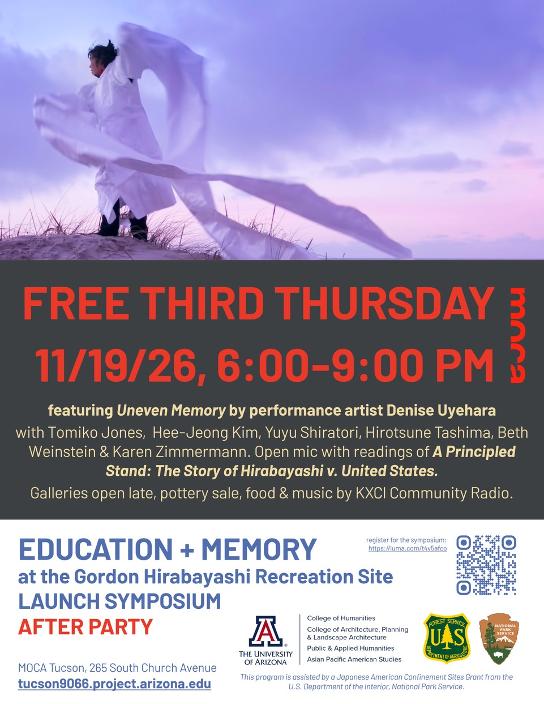
TUCSON 9066 AFTER PARTY @ MOCA’s Free Third Thursday
November 19, 2026, Thursday, 6:00-9:00 PM
LOCATION:
Museum of Contemporary Art (MOCA) Tucson
265 S Church Ave, Tucson, AZ 85701 [map].
Join us for music, readings and mingling after the symposium, in this after party co-hosted by MOCA Tucson as part of their Free Third Thursday program. Featuring Uneven Memory by performance artist Denise Uyehara, with Tomiko Jones, Hee-Jeong Kim, Yuyu Shiratori, Hirotsune Tashima, Beth Weinstein & Karen Zimmerman. There will be an open mic with readings of A Principled Stand: The Story of Hirabayashi v. United States. Galleries will be open late, with a pottery sale, food & music by KXCI Community Radio. No RSVP required.
An awardee of the 2026 Japanese American Confinement Sites Grant Program administered by the National Park Service, Tucson 9066: Education + Memory at Gordon Hirabayashi Recreation Site will bring public programs, guided site workshops, course materials, and a culminating digital/print publication to expand public understanding of GHRS as a historic Japanese American confinement site and a critical place for learning about citizenship, constitutional rights, and equal justice under the law. Learn more about the project at tucson9066.project.arizona.edu.”
Carolyn’s note: This was prison camp during WWII, for conscientious objectors, Hopi Indians, Japanese Americans.
Hirabayashi challenged his unlawful imprisonment, Hirabayashi v. US 320 vs. 81 (1943).

