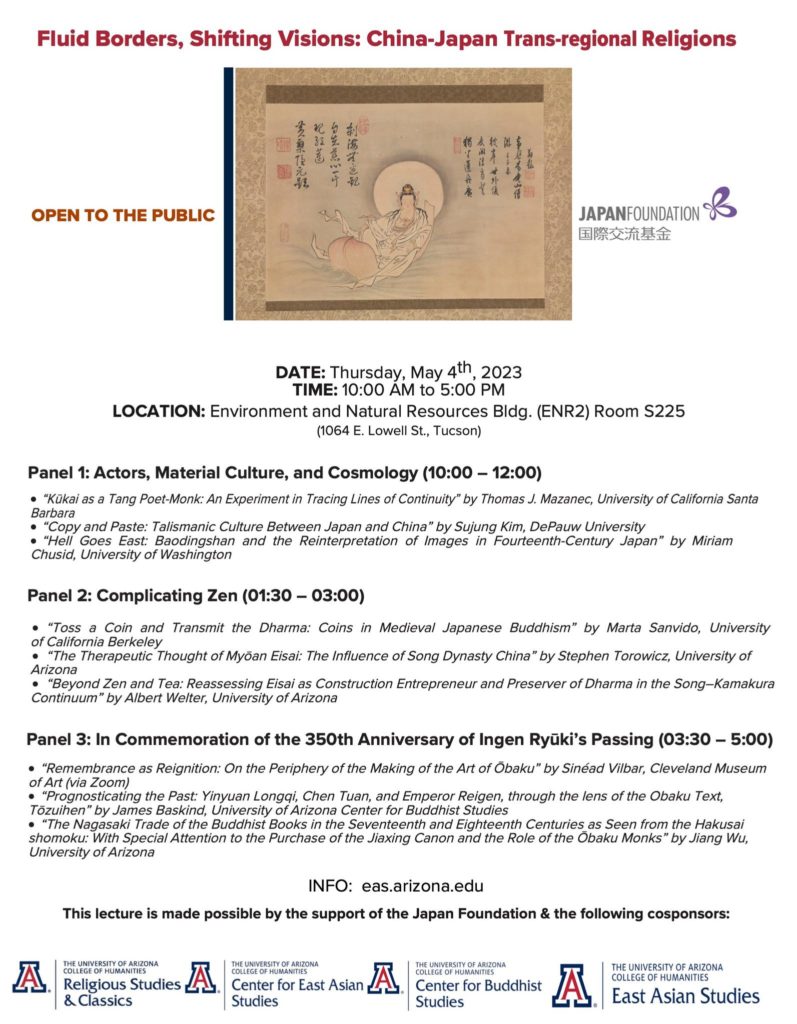
Fluid Borders,Shifting Visions: China-Japan Trans-regional Religions symposium on May 4 at UA ENR2 building
Reply
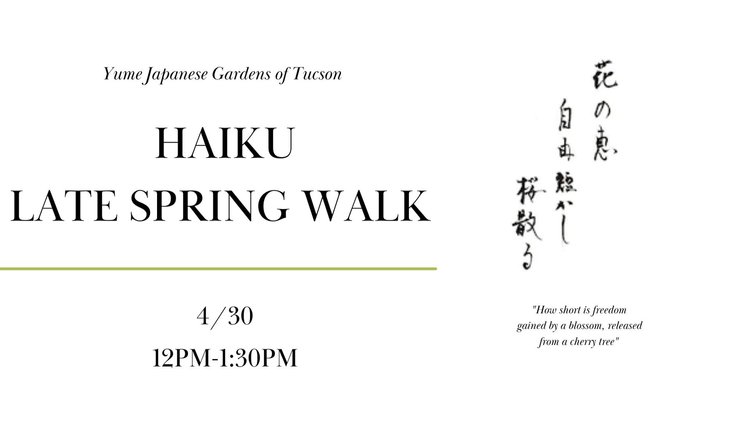
This will be our last Haiku workshop before Yume Gardens closes for the summer. We’ll continue our time together and in the garden, watching the changes and observing the AWARE (essential charm) of life, and writing haiku.
The workshop talk will be on Buson, the second of the great Haiku poets, the aesthetic concept of Yugen and its relationship to Japanese Buddhism, and haiku practice for the summer season.
Led by award-winning haiku poet Yukihiro Ibuki and Yume Cultural Director, Paul Amiel.
Date/Time:
Sunday, April 30th at 12PM
Tickets:
$20 general/$10 Members
Space is limited. Please reserve your spot!Purchase Tickets

Tucson Botanical Gardens is at 2150 N. Alvernon Way, north of Yume Japanese Gardens, south of Grant Rd. This exhibit is from 8 am to 5 pm on both days.
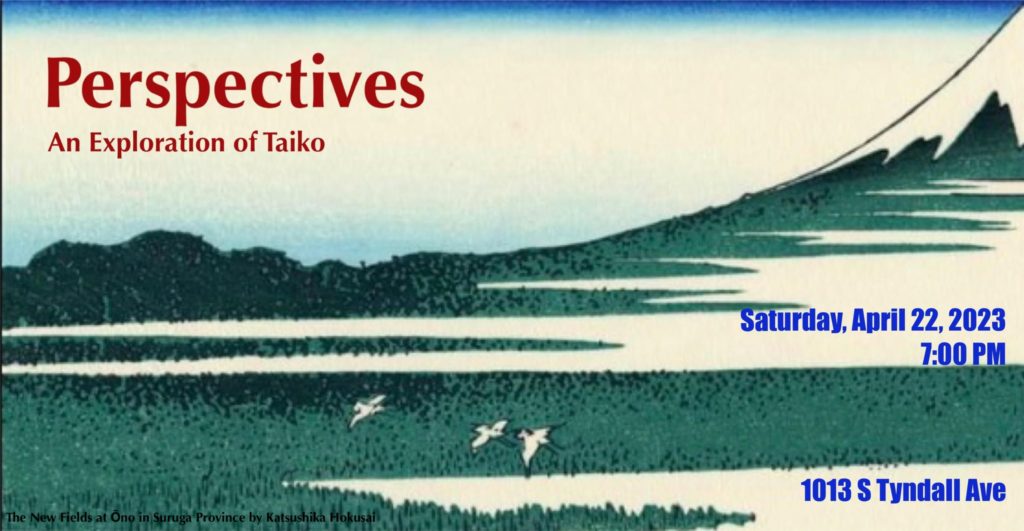
Event by Odaiko Sonora atRhythm Industry Performance Factory
“Join us Saturday, April 22nd at our studio as our Performing Ensemble and Understudies explore the history, inspirations, and spirit of taiko in this 90-minute concert.Tickets are sliding scale $10-15, and seats are first-come, first-served – buy your tickets in advance for access to the reserved front rows!Tickets can be purchased in advance or at the door via:
Venmo: venmo.com/odaikosonora
PayPal: paypal.me/tucsontaiko
Credit card: tinyurl.com/4fvkvwncTickets can also be purchased with cash at the door.There will be a brief intermission; please feel free to bring your own beverages. Masks are encouraged and appreciated. “
April 22 at 7 to 8:30 p.m.
The Early Books Lecture Series was established at the University of Arizona by Dr. Albrecht Classen, University Distinguished Professor of German Studies, nearly 20 years ago.
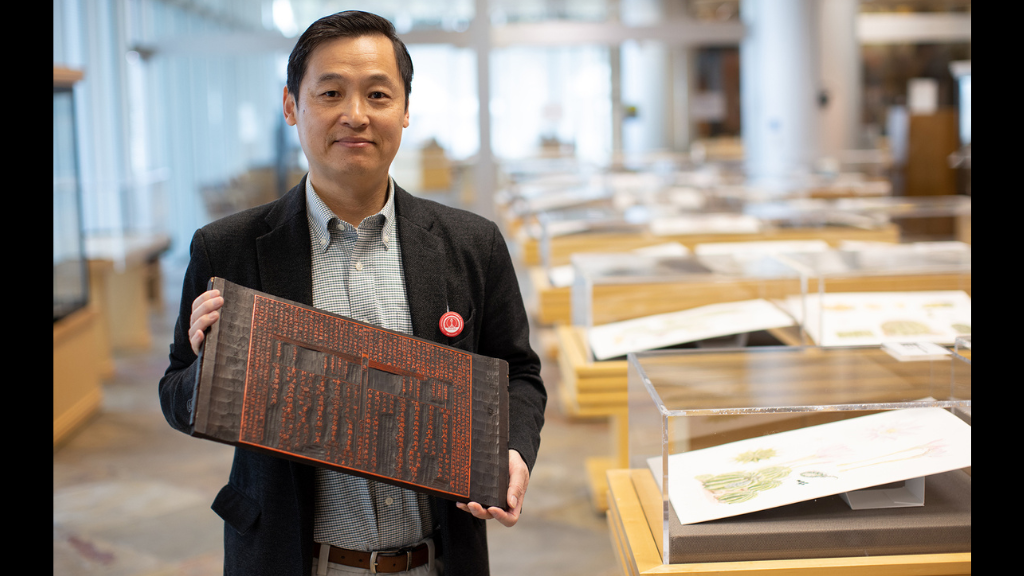
The Japanese Ōbaku Canon 黃檗藏 and Modern Buddhist Canon Compilations in East Asia is the third and final lecture in this year’s Early Books Lecture Series XVIII.
Date and time:Apr 18, 2023
4:00pm to 6:00pm
Location:
Main Library A313/314; 1510 E. University Blvd. Tucson, AZ 85721
“Although the creation of various modern Buddhist canons, such as the Taishō canon, is well-known in East Asia, little is known about the fact that the Ōbaku Canon, originated in early modern China but carved in Japan by the Japanese Ōbaku monk Tetsugen Dōkō 鐵眼道光 (1630-1682), a disciple of the Chinese monk Yinyuan Longqi 隱元隆琦 (1592-1673) and the founder of the Japanese Ōbaku Zen tradition.
This canon, however, was the first Chinese canon brought to Europe through the Japanese Iwakura mission in 1875. Both Samuel Beal (1825-1889) and Max Müller’s Japanese student Nanjō Bunyū 南條文雄 (1849-1927) translated its entire catalogue into English in 1876 and 1883 respectively. These catalogues, which predated all the modern canon compilations, introduced modern techniques of textual criticism which greatly influenced scholarly communities in Japan.
This lecture investigates the history of the Ōbaku Canon in China and Japan and evaluates its role in reinventing the Buddhist textual tradition in the modern era.
Registration
About the presenter
Dr. Jiang Wu (Ph.D., Harvard University, 2002) is director of the Center of Buddhist Studies and professor in the Department of East Asian Studies in the College of Humanities at the University of Arizona.
His research interests include seventeenth-century Chinese Buddhism, Chinese Buddhist canons, spatial analysis of religion, and the historical exchanges between Chinese and Japanese Buddhism. Dr. Wu is the author of numerous books and articles such as Enlightenment in Dispute (Oxford, 2008), Leaving for the Rising Sun (Oxford, 2015), and editor of Spreading Buddha’s Word in East Asia (Columbia, 2016), Reinventing the Tripitaka (Lexington, 2017), The Formation of Regional Religious Systems in Greater China (Routledge, 2022). “